
For almost 40 years, EnviroLift® has been used in the Australian market as a precast concrete pump station solution.
In this interview, Kevin Seeley, Managing Director of Global Water and the mind behind the precast concrete EnviroLift pump station design, explains why the system was developed and what made it different from traditional concrete pump station options of the day.
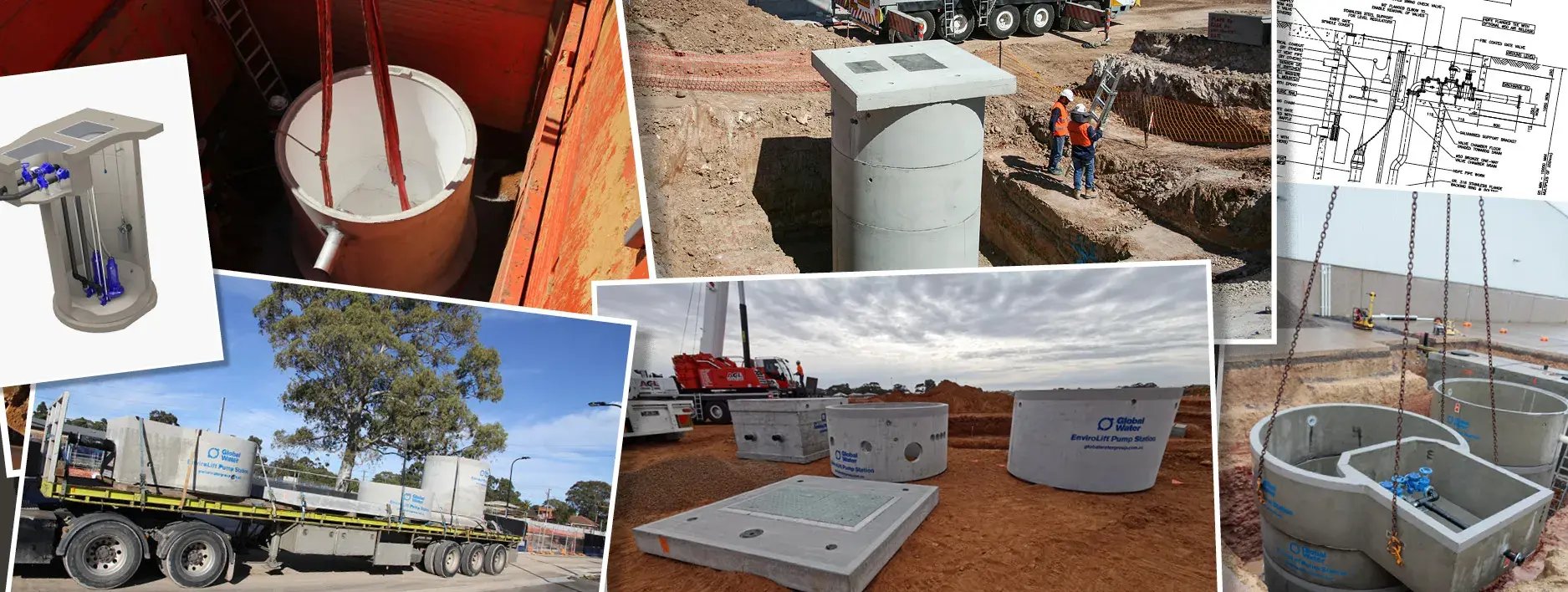
Originally developed in the late 80’s in South Australia, the EnviroLift was created to address specific problems found in traditional concrete pump station construction: rotational misalignment, site-finished bases, corrosion weak points, separate valve chambers, sludge build-up and confined space entry risks.
Today, EnviroLift is available Australia wide for developers, contractors, consultants and asset owners looking for a municipal standard modular precast concrete pump station designed for long-term sewer infrastructure.
Why was EnviroLift developed?
The EnviroLift was developed to improve how concrete sewer pump stations are built, transported, installed and maintained.
Before EnviroLift, traditional concrete pump stations were commonly made using spun concrete pipes with a poured base and a flat cover slab. This created several practical issues. The station depth was limited by transport height, the base and sludge batters poured separately and often depended on site finishing, lifting methods could create weak points in the concrete wall, and separate valve chambers required more excavation, pipework and installation time.
EnviroLift was designed to address these issues before the station reaches site.
What makes EnviroLift different from traditional concrete pump stations?
EnviroLift uses a modular precast mould-formed concrete design.
As the chamber is manufactured in a mould, key parts of the pump station can be formed under controlled conditions instead of being finished on site. This allows for more consistent reinforcement placement with consequent better control of concrete cover, mould-formed sludge batters and factory-prepared penetrations. In addition, the small batch concrete pour allows for customised concrete recipe including specialist aggregates and specific slump requirement.
The rotational keying allows stands and bases to be installed before delivery, helping reduce site work and deliver a more consistent finished concrete pump station.
Why is the modular precast design useful for deeper pump stations?
Traditional pre-assembled concrete pump stations were limited by the height that could be transported on a flatbed truck. In many cases, this limited the station to around four metres deep. The EnviroLift design however, is built in modular precast concrete sections, with chamber options ranging from 2 metres to 15 metres deep depending on the model.
This gives contractors and consultants more flexibility when designing sewer, stormwater or trade waste pump stations. This is especially true for sites where gravity drainage is not possible, or where deeper storage and pipework levels are required.
How does EnviroLift improve long-term durability?
Concrete sewer pump stations are exposed to corrosive gases. These hydrogen sulphide gases form acidic conditions on the chamber walls and attack the concrete over time.
EnviroLift uses high-strength sulphate-resistant cement and calcareous aggregate to improve concrete durability in sewer environments. The calcareous aggregate is alkali which helps neutralise acidic conditions inside the chamber, reducing the corrosive effect on the concrete.
The design also avoids improvised lifting holes in the chamber wall, which were common in older concrete pump station designs and could create weak points for corrosion to reach the reinforcement. pre-engineered Swift lifts are installed in all components for safe and speedy lifting.
EnviroLift is commonly referenced with a conservative 50-year design life, with engineering indicating a design service life of 100 years under suitable conditions.
How does EnviroLift reduce sludge build-up?
EnviroLift includes steep mould-formed sludge batters in the base of the concrete wet well.
In traditional concrete pump stations, sludge batters often had to be finished by hand after construction. This could limit the angle and consistency of the base.
With EnviroLift, the batters are formed in the mould high enough so that switch off level can be below the top of the sludge batter. This helps direct solids towards the pump suction and reduces areas where sludge can settle inside the wet well.
Some of the EnviroLift range including the Volym are available with the special SludgeKill base that is much higher sludge batter that completely surrounds the pump leaving only the pump diameter. This means that any sludge buildup is removed each time the pump runs.
How does EnviroLift reduce installation work on site?
EnviroLift reduces site work by having key features built into the precast concrete station before delivery. Such features include the modular keyed sections, inlet and outlet penetrations pre-cored, with pump bases and other components able to be prepared in the factory. This reduces the amount of forming, fitting and finishing required on site.
For civil contractors, this can mean faster installation, fewer site variables and less time spent working in and around the excavation.
What is the benefit of the integral valve chamber?
Traditional concrete pump station installations often use a separate valve pit installed away from the wet well. This requires a second excavation, additional pipework and more installation time. It can also create a risk of differential settlement between the pump station and the separate valve chamber.
EnviroLift has the option to include an integral valve chamber built into the pump station assembly. This reduces the overall footprint, removes the need for a separate valve pit and simplifies the pipework connection.
The pipework layout also supports easier servicing, with a 90-degree elbow in the pipework which acts as a dismantling joint, allowing service personnel to remove part of the pipework and access check valves and other components more easily.
How does EnviroLift reduce confined space entry?
Concrete sewer pump stations are confined spaces, and entry should be avoided where practical. In addition, WHS legislation requires that designers, manufacturers and installers of confined spaces must as far as practicable, eliminate the need to enter the confined space, and provide for the safe entry should a confined space entry be necessary.
EnviroLift was designed with additional features to specifically address these requirements:
- all 316 stainless fixings including flangesand a automatic well washing system reduces the need for routine entry to address corrosion and fat buildup
- provides easy access and adjustments tolevel controls
- confined space warning signage
- omits internal ladders to discourage unnecessary chamber entry
- safety grates that enable safe inspection and hosing down
- stainless inlet knife gate valve to enable positive isolation of the station
- use of radar or ultrasonic level control to eliminate the problem of fat buildup on float switches
These features help operators and asset owners reduce safety risk and support WHS obligations.
Who benefits from using an EnviroLift precast concrete pump station?
Developers benefit from a smaller footprint, giving fixed pump is like a less intrusive installation.
Contractors benefit from reduced excavation requirements, fewer site-built components and factory-prepared features.
Consultants benefit from a pre-engineered concrete pump station design with consistent construction details and quality.
Asset owners and operators benefit from durable materials, reduced confined space entry and easier access for maintenance.
How does the concrete pump station product range support different development needs?
Not every development needs the same concrete pump station design. Site size, inflow volume, emergency storage, pump size, installation depth and authority requirements can all affect the right choice.
Global Water manufacture a comprehensive concrete pump station range which includes options for smaller developments, standard municipal sewer infrastructure installations, and high-capacity or large storage projects.
The DrainAce range of precast concrete pump stations are suited to commercial wastewater or stormwater applications where a compact, durable concrete solution is required.
The EnviroLift modular precast concrete pump stations are designed for residential developments larger commercial sites, municipal sewer infrastructure, and larger stormwater and trade waste applications. The modular design allows the chamber depth and configuration to be matched to the project, while the integral valve chamber helps reduce footprint, excavation and installation complexity.
The EnviroLift Volym concrete pump station is the largest capacity precast station available in Australia with a capacity slightly more than a 3.8 M diameter station, but it's elliptical shape enables it to fit on a standard semitrailer without the need of police escort. They are suited tp high-capacity wastewater and stormwater projects where larger storage volume, larger pumps or more demanding infrastructure requirements are involved.
Need help selecting the right precast concrete pump station?
With almost 50 years of experience in pump station design and water infrastructure, the Global Water team can help you choose a precast concrete pump station that suits your site conditions, development requirements and long-term maintenance needs.
Whether your project involves sewer, stormwater or trade waste, our team can support you with practical advice, product selection and a proven concrete pump station range built for Australian conditions.
Thank you to Kevin Seeley for sharing the design thinking behind EnviroLift and the experience that shaped its development.
To discuss your next pump station project, get in touch with Global Water.
Tags: Concrete pump station