

As urban development expands into more challenging environments, traditional gravity sewer infrastructure is not always the most practical solution. Steep terrain, rocky ground, high groundwater and remote developments can all make deep trenching expensive and disruptive.
That’s where pressure sewer systems offer a smarter and more affordable alternative.
Pressure sewer technology is increasing across Australia and New Zealand for residential developments, regional communities, coastal areas and sites where conventional sewer infrastructure is difficult to install. By reducing the need for deep excavation and allowing greater flexibility in network design, pressure sewer systems provide an efficient solution for challenging wastewater applications.
This guide explains what a pressure sewer system is, how it works, where it is commonly used and why it is becoming a preferred wastewater solution for difficult sites.
What Is a Pressure Sewer System?
A pressure sewer system is a wastewater collection network that uses pumps to transfer sewage through small-diameter pressurised pipes rather than relying solely on gravity.
Unlike conventional gravity sewer systems, pressure sewer networks do not rely on extensive underground pipe networks laid at specific gradients. Instead they use grinder pumps installed at each property or collection point to transfer wastewater through sealed HDPE pipelines under pressure. This allows the system to follow natural land contours, reducing the need for deep excavation and extensive pipework.
In simple terms:
- Gravity sewer systems rely on carefully graded pipework to move wastewater downhill
- Pressure sewer systems use pump pressure to move wastewater through the network
This makes pressure sewer a practical option where terrain, ground conditions or existing infrastructure make traditional gravity sewer installation difficult or costly.
How Does a Pressure Sewer System Work?
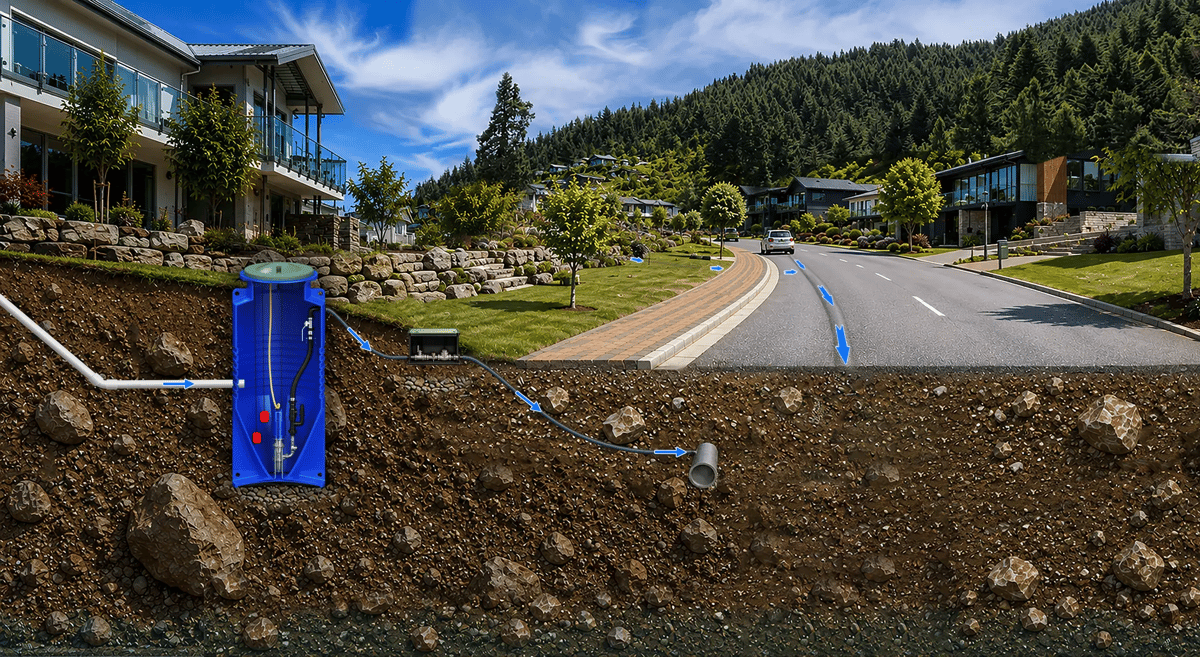
A pressure sewer system collects wastewater in an underground pump station, then uses a grinder pump to transfer it through a sealed, pressurised pipe network to a main sewer, central pump station or wastewater treatment facility.
1. Wastewater enters the pump station
Wastewater from homes, buildings or facilities flows into an underground collection chamber.
2. The grinder pump activates
When wastewater reaches a set level, the grinder pump automatically starts. The pump breaks down solids into a fine slurry and pushes wastewater into the pressure sewer network.
3. Wastewater travels through pressurised pipes
Unlike gravity sewer systems, pressure sewer systems do not rely on carefully graded pipework. Instead, wastewater is pumped through small-diameter HDPE pipes under pressure.
These pipes are typically:
- 40 mm–100 mm in diameter
- Installed at relatively shallow depths
- Routed around challenging terrain, existing services and site constraints
4. Wastewater reaches the sewer connection or treatment facility
The pressurised network transfers wastewater to a gravity sewer connection, central pump station or wastewater treatment facility.
Because the network is sealed and pressurised, wastewater can be transported across uneven terrain and over longer distances without requiring extensive excavation.
Put simply, pressure sewer systems are pump pressure rather than gravity to move wastewater. As the network is sealed and pressurised, it can follow natural land contours and reduce the need for deep excavation.
Pressure Sewer Systems vs Gravity Sewer Systems
The main difference between pressure sewer and gravity sewer systems is how wastewater moves through the network.
Gravity sewer systems rely on carefully graded pipework to move wastewater downhill. This often requires deeper trenching, larger pipes and more extensive excavation to maintain the correct fall across the site.
Pressure sewer systems use pump pressure to move wastewater through sealed pipework. Since they’re not dependent on gravity, the pressurised pipework can be installed at shallower depths and routed around terrain, services or existing infrastructure.
This can offer several advantages on challenging sites, including:
- Reduced excavation requirements
- Smaller pipe diameters
- Greater flexibility in pipeline routing
- Lower civil construction costs in challenging terrain
- Reduced disruption to existing infrastructure
For developments where achieving gravity grades would be difficult, disruptive or expensive, pressure sewer systems can provide a practical alternative.
Key Benefits of Pressure Sewer Systems
Reduced excavation requirements
Pressure sewer pipelines are commonly installed at shallower depths than traditional gravity sewer systems, helping to reduce trenching and site disruption.
Smaller pipe networks
As wastewater is pumped under pressure, smaller-diameter HDPE pipes can be used throughout the network.
Flexible design
Pressure sewer pipelines can follow the natural contours of the land, making them suitable for sloping, difficult or uneven terrain.
Lower installation costs on challenging sites
By reducing excavation requirements and simplifying pipe installation, pressure sewer systems can help lower civil construction costs where gravity sewer infrastructure would be expensive to build.
Suitable for difficult conditions
Pressure sewer systems are particularly effective in areas with:
- Rocky ground
- Sandy soils
- High groundwater
- Flat terrain
- Coastal environments
- Restricted excavation access
Long-term serviceability
Modern systems are designed for long-term performance, with modular and field-serviceable components helping simplify maintenance servicing, and asset management.
Where Are Pressure Sewer Systems Used?
Pressure sewer systems are commonly used in locations where traditional gravity sewer infrastructure is difficult, costly or impractical to install.
Typical applications include:
- Residential subdivisions
- Regional and remote communities
- Coastal and island developments
- Low-density developments
- Commercial developments
- Council sewer network expansions
They are particularly well suited to sites with rock, sandy soil, high groundwater, flat or undulating terrain, and areas where excavation access is restricted.
As pressure sewer networks require less excavation and can adapt to challenging site conditions, they are often selected for projects where conventional gravity systems would require significant civil works.
Local Pressure Sewer Expertise Across Australia and New Zealand
Every pressure sewer project is different and presents unique challenges. Terrain, groundwater conditions, local authority requirements and long-term maintenance needs can all influence network design and system selection.
Global Water's DrainAce Pressure Sewer Systems are engineered and assembled locally and are available throughout both Australia and New Zealand. Our experienced teams provide practical advice tailored to local site conditions, regulations and project requirements.
DrainAce systems are:
- Certified to AS/NZS 1546.1
- SA and NSW Health approved
- Designed with modular, field-serviceable components
- Supported by locally held parts and technical expertise
This combination of local support and proven infrastructure experience helps councils, developers, contractors and utilities deliver reliable long-term wastewater solutions.
Is a Pressure Sewer System Right for Your Project?
Pressure sewer systems are often the preferred solution when:
- Deep trenching is impractical
- Excavation costs are excessive
- The site has difficult terrain
- Existing infrastructure limits excavation
- Gravity grades are difficult to achieve
For many developments, pressure sewer infrastructure provides a flexible, cost-effective alternative to conventional gravity sewer systems, particularly where reduced excavation and adaptable pipework routing are important.
If you're planning a new development, expanding an existing wastewater network or exploring alternatives to gravity sewer infrastructure, contact the Global Water team for tailored advice on Pressure Sewer System solutions across Australia and New Zealand.
FAQ
Tags: Pressure sewer systems