

When planning a new wastewater network, choosing the right collection system can have a significant impact on construction costs, long-term maintenance and overall project performance.
While gravity sewer has traditionally been the standard approach, pressure sewer systems are increasingly being used for developments where challenging ground conditions or access to gravity sewer networks make conventional gravity-fed sewer networks more expensive to install.
Vacuum sewer systems are another alternative in very specific environments, particularly where shallow installation is required.
This guide compares gravity sewer and pressure sewer, explains how vacuum sewer systems differ, and explores the capital and operational costs associated with each approach.
Understanding the three main wastewater collection systems
All wastewater collection systems perform the same essential function: transporting sewage and wastewater from homes or buildings to a treatment plant or the existing sewer network.
The difference is how the wastewater moves.
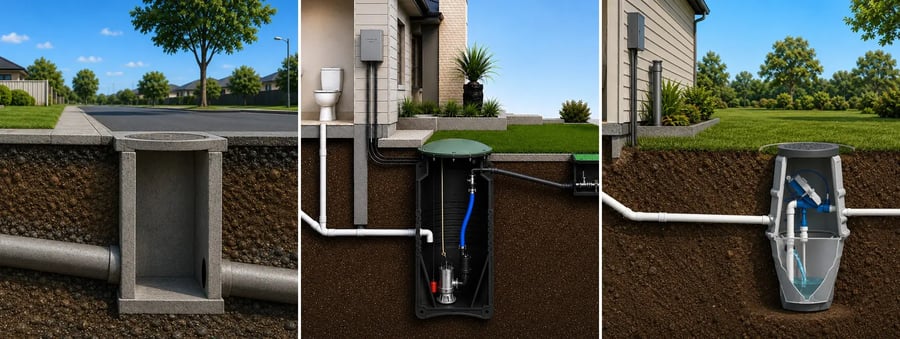
- Gravity sewer relies on the natural fall of the land to transfer the wastewater to the discharge location.
- Pressure sewer uses pumps to push wastewater through pressurised pipelines and because they’re pressurised they can be installed in more challenging terrain.
- Vacuum sewer uses suction from a central vacuum station to pull wastewater through the network to a singular collection point which is then pumped to the nearest municipal network .
The most suitable solution depends on factors such as topography, groundwater conditions, development density and whole-of-life costs.
Gravity Sewer vs Pressure Sewer
The key difference between gravity sewer and pressure sewer is:
- Gravity sewer uses the natural slope of the land to move wastewater
- Pressure sewer uses pumps to move wastewater under pressure
Although both systems achieve the same outcome, the infrastructure required - and the costs involved - can vary considerably.
Gravity Sewer Systems
Gravity sewer systems transport wastewater through underground pipes that are installed at carefully designed gradients, allowing sewage to flow naturally downhill.
They remain the most common wastewater collection method in established urban areas, residential subdivisions and town sewer networks throughout Australia and New Zealand.
Gravity sewer is often the preferred option where:
- The site has sufficient natural fall
- Existing gravity infrastructure is available
- Development density is relatively high
- Deep excavation is not required
However, where sites are flat, rocky or have high groundwater levels, maintaining the required pipe grades can result in deeper trenches, additional manholes and increased construction costs.
Note: Sewer pump stations are often incorporated into gravity sewer networks where wastewater needs to be lifted to a higher point. This differs from a pressure sewer system, where wastewater is pumped from each property throughout the network.
Pressure Sewer Systems
Instead of relying on gravity, pressure sewer systems use compact pump units installed at individual properties to transfer wastewater into a shared pressure main.
As the pipe network operates under pressure, pipes can generally be installed at shallower depths and do not require continuous downhill gradients.
Pressure sewer systems are commonly considered for:
- Rocky terrain
- High groundwater areas
- Coastal communities
- Undulating land
- Rural residential developments
- Remote development sites
- Low-density developments with widely spaced properties
Want to learn more about how pressure sewer systems operate? Read our guide: What Is a Pressure Sewer System?
Comparing CAPEX and OPEX
Selecting the right wastewater collection system isn't just about installation costs. It's equally important to understand the ongoing operational costs over the life of the network.
| System | CAPEX | OPEX |
|---|---|---|
| Gravity sewer | Often the highest in flat, rocky or difficult terrain due to deep excavation, extensive earthworks and supporting infrastructure such as manholes every 300 metres and at intersections. | Generally low where wastewater flows entirely by gravity. However, operating costs increase significantly if multiple pump stations are required throughout the network. |
| Pressure sewer | Can be significantly lower than gravity sewer in challenging terrain because smaller pipes and shallower trenches reduce excavation and civil works. | Typically around 30% lower than comparable gravity networks, largely because the network requires minimal above-ground infrastructure and fewer large pump stations. |
| Vacuum sewer | Can be competitive in flat or high-groundwater areas due to shallow pipe installation, although the central vacuum station represents a significant capital investment. | Generally higher than pressure sewer because vacuum valves and the central vacuum station require specialised servicing and maintenance. |
CAPEX (Capital Expenditure)
The upfront investment required to design, purchase and construct the system.
OPEX (Operational Expenditure)
The ongoing costs of operating, servicing and maintaining the infrastructure.
Looking beyond upfront construction costs is important when evaluating wastewater infrastructure. In many developments, lower operational costs can significantly reduce whole-of-life expenditure.
Pressure Sewer vs Vacuum Sewer
Pressure sewer and vacuum sewer systems are often considered where gravity sewer is difficult or uneconomical to construct.
Although both reduce the need for deep gravity pipelines, they operate in different ways.
The key distinction between pressure sewer and vacuum sewer is:
- Pressure sewer pushes wastewater
- Vacuum sewer pulls wastewater
Pressure Sewer
Pressure sewer systems use positive pressure generated by centrifugal pumps to move wastewater through a small-diameter pressure pipeline.
As each property manages its own pumping, there is generally no need for a large central pumping facility, making the system flexible for developments spread across varying terrain.
Pressure sewer is often selected where conventional gravity sewer would require extensive excavation or multiple intermediate pump stations.
Vacuum Sewer
Vacuum sewer systems rely on negative pressure. Wastewater first enters a collection chamber before a vacuum valve opens, allowing suction from a central vacuum station to transport wastewater through the network.
Vacuum sewer systems can be suitable for:
- Flat coastal developments
- High groundwater areas
- Environmentally sensitive locations
- Sites where shallow pipe installation is preferred
However, the central vacuum station and vacuum valves require specialist maintenance, which should be considered when evaluating long-term operating costs. They also require a site for the building to house the vacuum pumps and receiving tank which is usually large and expensive to construct. This system also requires the PVC Pipe network to be installed at very specific grades and does not follow the natural contours of the land.
Which wastewater collection system is best?
No single wastewater collection system is the ‘best’ choice for every project. The most appropriate solution depends on site conditions, available infrastructure, environmental constraints and lifecycle costs.
Gravity sewer may be the preferred option when:
- Natural ground fall is available
- Existing gravity infrastructure can be utilised
- Deep excavation is not required
- Development density is high
Pressure sewer is often better suited where:
- High groundwater is present
- Rock excavation would increase construction costs
- Properties are widely spaced
- Reducing excavation and infrastructure costs is a priority
- Smart network utilisation is required due to municipal constraints
Vacuum sewer may be suitable where:
- Shallow installation is essential
- Environmental sensitivity is a key consideration
- High groundwater conditions exist
- A central vacuum station is practical for the development
Choosing the right sewer system
Selecting between gravity, pressure and vacuum sewer systems requires balancing construction costs, operational expenditure and long-term performance. While gravity sewer remains an effective solution in many conventional developments, a pressure sewer system can provide significant advantages where topography, groundwater or site conditions make traditional gravity infrastructure more complex or expensive.
Global Water supplies pressure sewer solutions across Australia and New Zealand and works with councils, developers and consulting engineers to identify the most suitable wastewater collection system for each project.
Talk to our team
If you're comparing wastewater collection systems for an upcoming development, our team can help assess your site and recommend the most appropriate solution.
Get in touch with Global Water to discuss pressure sewer systems and wastewater infrastructure solutions tailored to projects across Australia and New Zealand.
Tags: Pressure sewer systems